



Have you ever pulled a beautiful steak from the oven, only to find the center is still cold? Or watched a delicate piece of fish turn to rubber in a pan? That moment of disappointment is all too familiar. It’s the gap between your culinary vision and the harsh reality of traditional cooking.
What if you could close that gap for good? Imagine serving perfectly cooked food every single time. Food that is juicy, tender, and exactly how you dreamed it would be. This is the promise of a modern cooking method that relies on absolute precision.
Enter a new tool designed for home chefs. It combines accurate temperature control with the convenience of app connectivity. For around $85, it aims to bring restaurant-quality results into your kitchen. The brand behind it is known for its expertise in managing heat.
This review will explore if this machine is the right tool to elevate your meals. We’ll look at its performance, features, and how it stacks up against other options. Let’s find out if it can help you cook with newfound confidence.
Table of Contents
Key Takeaways
- This device is built for achieving consistent, high-quality results at home.
- Its core strength lies in maintaining exact water temperature for flawless cooking.
- You can manage your cooking remotely via a smartphone app for added convenience.
- Priced competitively, it offers a smart entry into precision kitchen equipment.
- The manufacturer has a strong background in temperature-control technology.
- This article provides a detailed analysis to help you make an informed purchase decision.
- The ultimate goal is to empower you to cook with incredible accuracy and ease.
Introduction to the INKBIRD WIFI Sous Vide Cooker ISV-100W
Precision cooking transforms how you prepare meals, delivering consistent results that traditional methods often miss. This approach relies on exact temperature management to achieve perfect doneness. A new generation of kitchen tools makes this technique accessible to home chefs.
What is Sous Vide Cooking?
Sous vide is a French term meaning “under vacuum.” It describes a specific culinary method. Food is sealed in a bag, often using a vacuum sealer, and placed in a water bath.
The water is heated and circulated by a device called an immersion circulator. This machine maintains a precise, steady temperature for the entire cook time. The result is food cooked evenly from edge to edge.
This technique offers remarkable benefits. It locks in juices, leading to incredibly moist proteins. It also tenderizes tougher cuts of meat over longer cooking times. You get consistent, restaurant-quality results every time you cook.
Why Consider the INKBIRD ISV-100W?
The ISV-100W is an immersion circulator designed for modern kitchens. It brings together manual controls and smart app connectivity. This dual approach gives you flexibility in how you manage your recipes.
You can set time and temperature directly on the unit’s touch panel. Alternatively, use the smartphone app for wireless control. This allows for remote monitoring and adjustments from another room.
This model is ideal for tech-savvy cooks who value convenience. It’s also excellent for beginners learning the basics of this cooking style. The device supports water containers up to 15 liters in capacity.
Compared to simpler, non-connected circulators, the added WiFi functionality is a significant upgrade. It serves as a bridge between basic equipment and a fully integrated smart kitchen. The brand’s expertise in temperature-regulation technology ensures reliable performance.
| Feature | Basic Sous Vide Machine | This Smart Model |
|---|---|---|
| Control Method | Manual dial or buttons | Touchscreen panel & smartphone app |
| Connectivity | None | WiFi for remote access |
| Temperature Precision | ±1°C (1.8°F) | ±0.5°C (0.9°F) |
| Maximum Capacity | Typically 10 liters | Up to 15 liters |
| Typical Price Range | $50 – $70 | $80 – $100 |
This comparison highlights the value of the connected features. You gain greater control and convenience for a moderate increase in cost. It’s an investment that can elevate your entire cooking experience.
Detailed Specifications and Build Quality
Solid construction and precise engineering are what separate reliable equipment from the rest. This section breaks down the physical form and technical details that define this device’s capabilities.
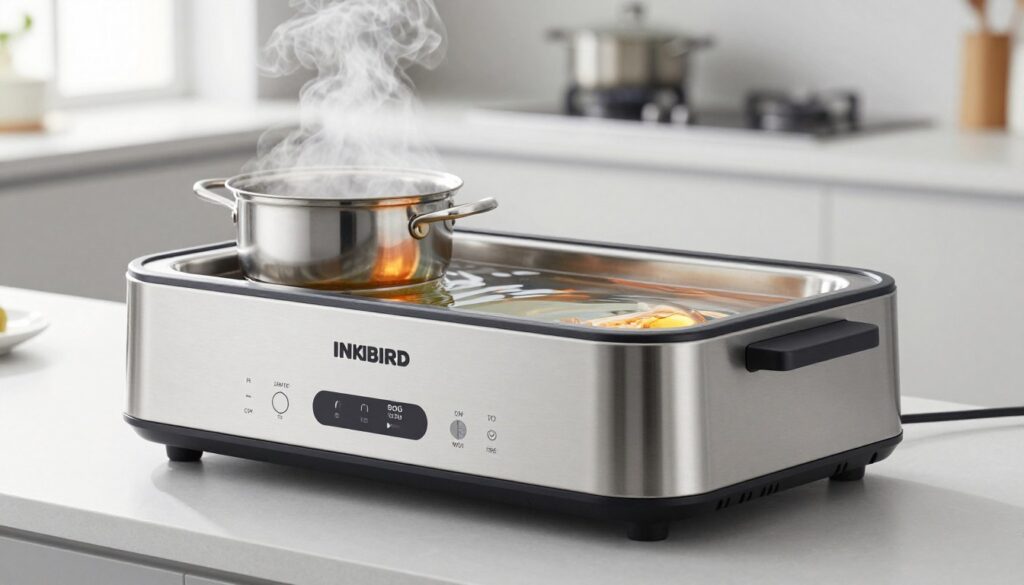
Understanding these specs helps you know exactly what you’re getting. It shows how the tool will fit into your kitchen and perform for your recipes.
Physical Design and Dimensions
The unit features a sleek, cylindrical design. It stands 16.5 inches tall with a diameter of 2.75 inches.
This compact shape makes it relatively easy to store in a drawer or cabinet. You won’t need to dedicate permanent counter space to it.
It has a solid feel, weighing in at just over 3 pounds (1.2 kg). The build uses quality materials that inspire confidence during use.
The power cable is a generous 47.2 inches long. This gives you flexibility when placing your water pot relative to a kitchen outlet.
Core Technical Specifications
Under the hood, this machine is built for performance. A 1000-watt heating element provides quick and efficient warming.
The temperature range is broad, from 77°F to 210°F. This allows for everything from delicate fish to pasteurization tasks.
Its most impressive spec is the temperature control accuracy of ±1°F. This level of precision is crucial for consistent results.
You can set cook times up to 99 hours and 59 minutes. This is perfect for transforming tough cuts of meat into tender masterpieces.
A clear dot matrix LCD screen shows set and actual temperature, time, and status. The interface is straightforward and easy to read.
The recommended maximum water bath capacity is 15 liters. This guides you in selecting an appropriate pot or container for your meals.
It’s available in different voltage models (120V or 220~240V). Ensure you purchase the correct variant for your region.
| Specification | Basic Immersion Circulator | This Smart Model | High-End Pro Model |
|---|---|---|---|
| Heating Power | 800W | 1000W | 1200W |
| Temp Accuracy | ±2°F | ±1°F | ±0.5°F |
| Max Capacity | 10 Liters | 15 Liters | 20+ Liters |
| Connectivity | None | WiFi & App | WiFi, App, Voice |
| Typical Price Point | Budget ($50-$70) | Mid-Range ($80-$100) | Premium ($150+) |
This comparison shows its strong position. It offers superior power and accuracy over basic units, with smart features at a mid-range price.
You get pro-level precision without the premium cost. It’s a balanced choice for serious home cooks.
Precision Cooking: Temperature Performance and Accuracy
Achieving perfect doneness in your meals hinges entirely on two factors: how quickly your device heats up and how steadily it holds that heat. This is the core of any precision cooking method. We put this unit through its paces to see how it performs where it matters most.
You’ll find a mix of strengths here. The heating speed is practical but not the fastest. The temperature stability, however, is where this machine truly shines.
Heating Power and Speed
This circulator packs a 1000-watt heating element. On paper, that suggests quick warm-up times for your water bath.
Real-world tests tell a slightly different story. Independent reviews note its time to reach a target temperature is slower than some rival models with similar power.
What does this mean for your kitchen routine? You’ll wait a few extra minutes for the water to get ready. For most planned cooks, this is a minor inconvenience, not a deal-breaker.
You simply need to factor it in when starting your recipe. The trade-off is access to exceptional holding accuracy once the set point is reached.
Temperature Control and Consistency
Here is where this tool earns its keep. Its temperature accuracy is excellent, with no overshoot when hitting your desired setting.
Once set, it maintains that heat with minimal variation. This stability is crucial for achieving precise doneness, especially with delicate proteins like fish or eggs.
The unit employs a “3D water circulation” heating technology. This helps ensure even heat distribution throughout the entire pot, eliminating cold spots.
Professional kitchens demand accuracy within 1°F or better. This machine meets that standard, making repeatable, restaurant-quality results possible at home.
“Precision isn’t just about hitting a number; it’s about holding it steady for hours. That consistency is what transforms good food into great food.”
This level of control is also vital for food safety during long cooks. It keeps harmful bacteria at bay by ensuring the water never dips below a safe temperature.
Imagine a steak cooked medium-rare from edge to edge, with no gray banding. Or eggs with a custard-like yolk every single time. That’s the practical benefit of this rock-solid temperature performance.
While heating speed is a noted drawback, the holding accuracy is a significant advantage for serious cooks.
Smart Features: WiFi Connectivity and App Control
Connecting your cooking appliance to your smartphone might seem like a luxury, until you experience the convenience firsthand. This is where modern kitchen tools truly separate themselves from basic models.
The ability to manage your meal from another room changes everything. It turns a rigid process into a flexible part of your daily routine.
This device’s smart functionality operates on standard 2.4GHz home networks. The primary benefit is clear: complete control from anywhere via your phone.
You are no longer tethered to the kitchen counter. This freedom is a significant upgrade for any home chef.
Best Amazon Picks:
Setting Up the INKBIRD App
Getting started is straightforward. First, download the official app from the iOS App Store or Google Play Store.
Ensure your phone is connected to your home’s 2.4GHz WiFi band. The unit does not connect to 5GHz networks, which is common for many smart home devices.
Power on the immersion circulator and follow the in-app prompts. The process involves selecting your home network and entering the password.
Once paired, the device appears in your app’s device list. The connection is usually stable and quick to establish.
Remote Monitoring and Adjustments
The app interface is clean and intuitive. You can set the target temperature and cook time with simple sliders and inputs.
Starting or stopping the machine is just a tap away. Most importantly, you can monitor the current water temperature in real-time.
This allows for remote adjustments without being in the kitchen. Need to extend a long braise while you’re out? You can do that easily.
Push notifications alert you when the cook is complete. You can also receive alerts if the water level gets too low or another issue arises.
For beginners, the app includes preset programs for common items. These are one-touch recipes for steak, chicken breast, and pork chops.
They simplify the process by providing trusted time and temperature combinations. It’s a helpful guide that builds confidence.
“Remote control isn’t about being lazy; it’s about being efficient. It gives you back your most valuable resource—time.”
Consider starting a pot roast before you leave for work. You can monitor its progress and know it will be ready when you get home.
Adjusting a delicate custard cook from the living room is another game-changer. The app makes this precision method more accessible than ever.
The main limitation is the need for a stable WiFi connection. If your network drops, remote functions will be unavailable until it’s restored.
Thankfully, the physical control panel remains fully operational. This dual approach ensures you’re never locked out of managing your meal.
This smart control contrasts with simpler units that offer only manual buttons. It sets the stage for a deeper look at the overall user experience next.
User Experience: Setup, Interface, and Ease of Use
The true test of any kitchen gadget isn’t just its specs, but how smoothly it fits into your daily routine. A device can promise perfect results, yet frustrate you every time you try to use it. This section looks at the hands-on interaction, from initial setup to daily operation.
Getting started is physically simple. You clip the circulator to the side of your pot, fill it with water, and plug it in. The build feels sturdy during this process. The real user experience challenge begins when you turn it on and face the control panel.
Control Panel Navigation
The physical interface has a dot-matrix LCD screen and four touch-sensitive buttons. These are typically for power, up, down, and set functions. At a glance, it looks straightforward.
Unfortunately, the logic behind setting a temperature manually is not intuitive. The process requires a specific sequence of presses on the “Set” button. It’s easy to lose your place in the menu.
You might think you’ve confirmed a new setting, only to find the machine reverting to its previous temperature. This interface issue is a significant flaw. It can lead to cooking errors if you don’t double-check the screen carefully.
For a tool built on precision, this lack of clear feedback is puzzling. It creates an unnecessary learning curve. Users who prefer manual controls over the app will find this particularly frustrating.
Manual and Documentation
The included printed guide does little to help. It is often described as incomplete and difficult to follow. You won’t find detailed troubleshooting steps or a comprehensive chart for cook times.
This forces you to seek information online or rely on guesswork. For beginners, a clear manual is crucial for building confidence with a new cooking method. Its absence here is a missed opportunity.
These shortcomings in physical interaction affect the overall experience. They add friction to what should be a seamless process.
The best practice is to use the smartphone app for all setup and adjustments. The app’s interface is far clearer. Always verify the target temperature on the machine’s screen after using the app, however.
Compared to competing models with a single dial or more logical buttons, this unit’s onboard control scheme feels like a step backward. It prioritizes smart features over basic usability.
A firmware update could easily fix this by simplifying the button logic. Until then, the app is your best friend for a stress-free experience.
This critique highlights a key trade-off. You gain excellent remote capabilities but deal with a subpar local interface. For tech-savvy cooks who live on their phones, it’s a minor hurdle. For others, it’s the device’s most notable weakness.
Pros and Cons of the INKBIRD ISV-100W
To decide if this is the right tool for you, let’s break down its most praised features and its most common criticisms. A balanced look at strengths and weaknesses helps you match the device to your cooking style and expectations.
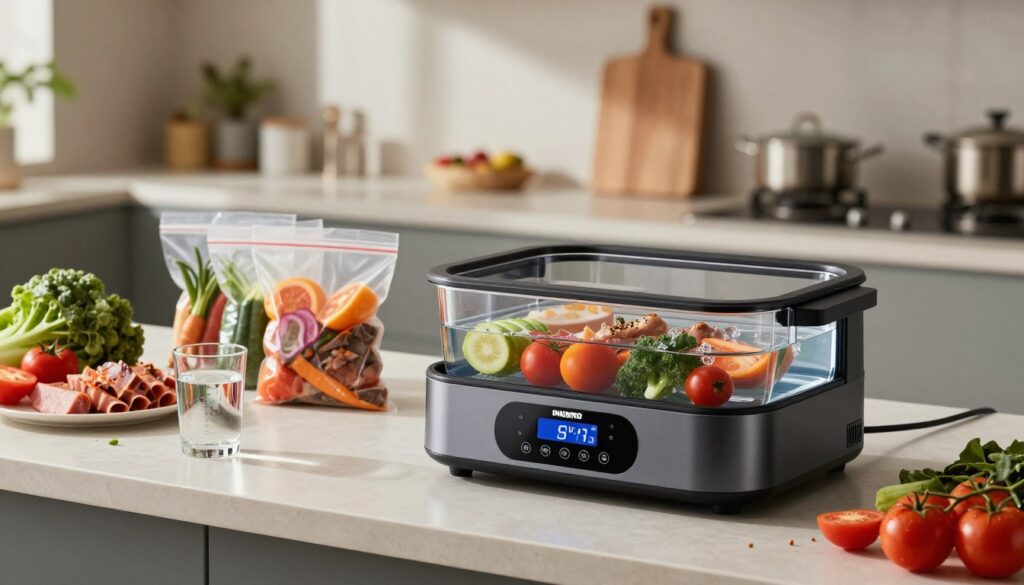
This model offers a compelling mix of high-end performance and smart convenience at a mid-range cost. However, it also has a few notable quirks that impact the daily user experience.
Best Amazon Picks:
Advantages: What We Like
Top-tier temperature accuracy is its greatest strength. The machine holds a steady heat with minimal fluctuation. This precision is the entire point of the cooking method, ensuring perfect doneness every time.
Operation is remarkably quiet. You won’t hear a loud pump or motor disrupting your kitchen. This makes it suitable for open-plan living spaces.
Its compact, cylindrical design is easy to store. You can tuck it in a drawer instead of leaving it on the counter. This is a practical benefit for kitchens with limited space.
The price is very competitive for a model with WiFi connectivity. You get smart features without a premium cost. It represents strong value in the market.
App control is reliable and adds real convenience. Remote monitoring and adjustments work well on a stable network. This functionality is a significant upgrade over basic units.
Drawbacks: What Could Be Improved
Heating speed is slower than some competing models with similar power. You’ll wait a few extra minutes for the water to reach your target. For most planned cooks, this is a minor inconvenience.
The most significant issue is the unintuitive physical control panel. The button logic for manual setup is confusing and prone to error. This creates an unnecessary hurdle for users who prefer not to use the app.
The included user manual is not very helpful. It lacks clear troubleshooting and comprehensive guides. Beginners may need to seek information online to feel confident.
As a first-generation product, its long-term reliability track record isn’t established yet. The brand does offer a multi-year warranty and a 30-day return policy. These customer service policies help mitigate concerns about durability.
For tech-savvy cooks who primarily use the app, the control panel flaw is a small trade-off. For those who dislike smartphone-dependent kitchen gadgets, it can be a deal-breaker.
You are essentially trading some user-friendliness for excellent core performance and smart features at a low price. If the control panel issue were fixed via a firmware update, this machine would be a highly recommended pick.
| Advantages (Pros) | Disadvantages (Cons) |
|---|---|
| Excellent temperature accuracy and stability (±1°F) | Slower heating speed compared to some rivals |
| Quiet operation with minimal noise | Frustrating and non-intuitive physical control panel |
| Compact, space-saving design for easy storage | Unhelpful and incomplete user manual |
| Very competitive price for a WiFi-enabled circulator | First-gen product with unknown long-term reliability |
| Reliable app connectivity for remote monitoring & control | Requires a stable 2.4GHz WiFi network for full functionality |
“The best value often lies in a tool that excels at its core function, even if it has rough edges elsewhere. For precision cooking, that core function is unwavering temperature control.”
This device delivers exceptional results where it matters most: in the water bath. Its smart features add modern convenience. The main compromises are in the physical interface and initial warm-up time.
How It Compares to Other Sous Vide Machines
How does this device stack up against established competitors and other models from the same brand? Making the right choice requires a clear comparison. You need to see where it excels and where it makes compromises.
This analysis looks at two key areas. First, we’ll pit it against popular rivals in its price class. Second, we’ll see how it fits within its own brand’s lineup.
vs. Popular Competitor Models
Common rivals include the Anova Nano and the ChefSteps Joule. These are well-known names with strong followings.
The ISV-100W often wins on pure temperature accuracy. Its ±1°F stability matches or beats more expensive units. This is its single biggest performance advantage.
It also wins on price for a WiFi model. You can often find it for around $85. A comparable Joule or Anova with connectivity costs significantly more.
Where does it fall short? Heating speed is a noted area. It warms water slower than some competitors with similar wattage.
Brand recognition is another factor. Anova and Joule have more user reviews and community support. The physical user interface on this model is also less polished.
“You’re trading some brand cachet and interface polish for exceptional core performance at a lower cost. For many cooks, that’s a smart trade.”
The app experience is generally reliable and comparable. All three devices allow for remote monitoring and control.
Within the INKBIRD Family
This brand offers several immersion circulators. Understanding the differences helps you pick the right one.
| Model | Key Differentiators | Best For |
|---|---|---|
| ISV-100W (This Model) | Wide temp range (77°F-210°F), Dot-matrix screen, WiFi connectivity | Users wanting app control and a wider low-temp range for delicate food. |
| ISV-101W | Similar to 100W but may have a different control scheme or housing. | A very close alternative, often with minor feature tweaks. |
| ISV-200W | Often features a TFT color screen, different button layout. | Those who prefer a more modern display and potentially simpler controls. |
| ISV-300W | May include features like a booking timer or alarm functions. | Cooks who want advanced scheduling for their recipes. |
The ISV-100W holds a specific spot. It offers the essential smart feature (WiFi) with a proven, accurate heating system.
Value for Money Assessment
For about $85, you get two premium features: exceptional temperature control and WiFi connectivity. These are often found on machines costing $50 to $100 more.
This is the heart of its value proposition. You are accepting specific trade-offs to get that price.
- You Get: Pro-level precision, remote app control, quiet operation.
- You Accept: A clunky physical interface, a slower heat-up time, a newer brand name.
After-sales support is crucial for any new product. The brand states policies for free fast shipping and a multi-year, hassle-free warranty. This helps mitigate concerns about long-term reliability.
So, is it the right tool for you? Your decision hinges on priorities.
If your top needs are budget and precision, this model is a very strong contender. It delivers on the core promise of the cooking method flawlessly.
If a seamless, intuitive out-of-box experience is critical, you might look at more established brands. They often invest more in user interface design.
In summary, this immersion circulator is a “specs and performance” bargain. It requires a slight tolerance for an initial learning curve. In return, it provides the accuracy and control needed for perfect food every time.
Best Amazon Picks:
Conclusion: Is the INKBIRD ISV-100W Right for You?
So, should this device find a place in your kitchen arsenal? The answer depends on your priorities.
This model delivers exceptional temperature precision, the most critical factor for perfect food. It adds convenient app control at a very competitive price. This combination offers outstanding value for money.
The major drawback is its frustrating physical interface. The ideal user relies on the smartphone app for primary control. They value accuracy and budget over a seamless out-of-box experience.
If you prefer simple knobs or need the fastest heating, look elsewhere. For app-centric cooks who can overlook the panel, this immersion circulator is a highly recommended performer. A future firmware update could make it a top pick.
Weigh its core strengths against its interface quirks. If it sounds right for your cooking style, it’s a tool that can elevate your meals.
FAQ
How do I connect this immersion circulator to my home network?
You connect it using the dedicated mobile application. The app guides you through a simple process to link the device to your 2.4GHz WiFi network, allowing for remote control from your smartphone.
Do I need a special container or pot to use this machine?
No, you don’t need a specialized container. This circulator is designed to clamp onto most standard pots, stockpots, or large containers you already have in your kitchen. Just ensure it’s deep enough to fully submerge the food.
Can I use it without the smartphone app?
Yes, absolutely. You can operate it completely manually using the intuitive button interface and clear display on the unit itself. The app adds convenient remote features, but it’s not required for basic cooking.
Is a vacuum sealer necessary for this cooking method?
A> While a vacuum sealer provides the best results, it’s not strictly required. You can use the water displacement method with high-quality zip-top bags, pressing out as much air as possible before sealing. Many home cooks start this way.
How does its performance compare to more expensive brands like Anova or Joule?
A> This model offers excellent value, matching core performance in heating speed and temperature accuracy. The main differences often lie in premium materials or advanced app ecosystems. For precise, reliable results, this device is a strong competitor.
What is the maximum water capacity it can handle?
A> The unit is powerful enough to effectively circulate and maintain temperature in large volumes, suitable for most home cooking tasks. It can easily handle a standard 12-quart stockpot or larger container, perfect for cooking multiple portions.
How do I clean and maintain the equipment?
A> Maintenance is straightforward. The stainless steel shaft and circulator housing can be wiped clean with a damp cloth. For a deeper clean, you can descale the heating element using a mixture of vinegar and water, similar to other kitchen appliances.
